


Just one week ago, coming off a dominant victory over Ole Miss to reach 4-0, it would have been difficult to find a Florida fan who felt anything but elation over first-year coach Jon Sumrall.
But by Saturday night, the tables had turned on the Gators in a 45-17 loss at Missouri, and the online discourse around Sumrall had quickly turned toxic.
"There better be staff changes Day 1 of offseason," one verified Florida fan account with more than 1,000 followers posted on X. Another with 2,000 followers, whose account was subsequently suspended, made a profane critique of Sumrall for going on a podcast tour after the Ole Miss win and not having his team ready to play. On a popular Gators message board, there were separate threads calling for the firing of defensive coordinator Brad White and mega-booster Gary Condron as well as one calling Sumrall a "fraud."
While overheated social media rhetoric is a feature and not a bug of college football fandom, it does feel like the first half of the 2026 season has been defined by more emotional volatility and less patience than ever before.
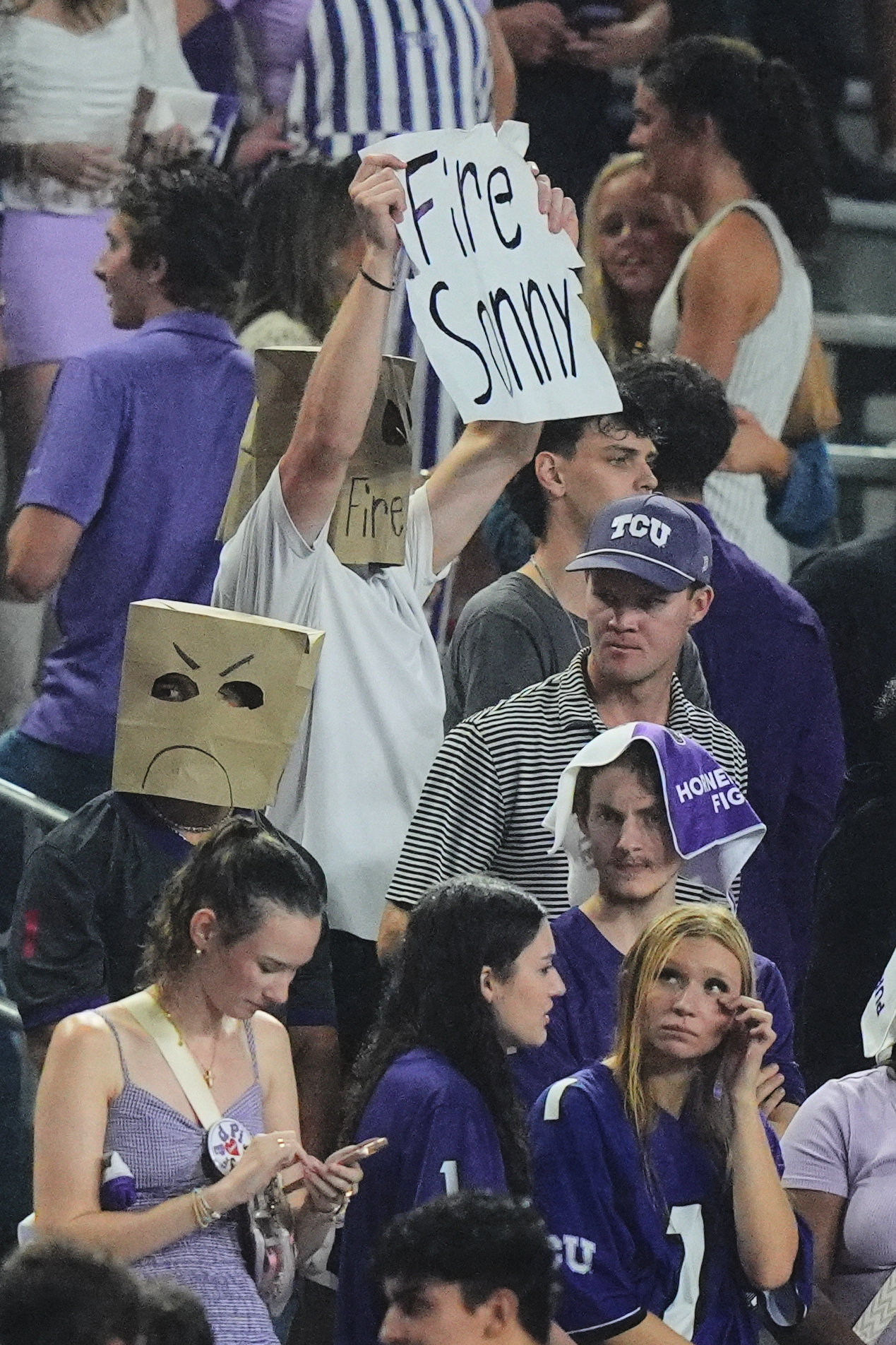
Whether it's a group of TCU fans wearing paper bags this past week against BYU to protest head coach Sonny Dykes, Florida State coach Mike Norvell being booed during the introductions before a big win over Virginia or Arkansas fans openly speculating whether first-year coach Ryan Silverfield might be one-and-done, a sport that is supposed to provide joy and community seems at the moment to instead be a source of frustration in so many places.
While the online conversation only represents the most fervent sliver of every fan base, the atmosphere around college football feels like it is getting progressively more intense and more toxic. It's not just the fans, either. Administrators are feeling the stress of one bad football season putting their jobs in jeopardy. Coaches' capacity for patience is getting squeezed, too — just look at the sideline blowup at Colorado State last weekend between Jim Mora and defensive coordinator Tyson Summers, who walked off the job mid-game after getting stripped of his play-calling duties.
A certain level of bizarre makes college football what it is. But why does it seem this season like it's driving everyone up the wall?
The answer lies within the vast realm of one word: Disruption.
Just think about the amount of change college football has endured within a short period of time.
Players went from not being paid to making, in some cases, millions of dollars annually, spreading the talent around in ways that weren't happening under the old model.
The concept of team building went from developing multiple recruiting classes over the course of several years to a plug-and-play model where relying too much on prospects, even elite ones, can be a disadvantage.
Fans and administrators used to judge coaches partly on their ability to attract talent, even if it meant overlooking deficiencies in their strategic and technical prowess. Now, it seems the only meaningful measure of building a roster is money, meaning schools that aren't winning have to ask their fans for more of it at the very moment their frustration with the product is highest.
Conferences completely remade themselves, with the SEC absorbing two more historic powers in Texas and Oklahoma and the Big Ten adding the best programs from the West Coast, making both leagues more difficult to win and also more uneven from a scheduling standpoint.
The playoff has gone from four teams to 12, and now possibly to 24 as soon as next season, which is great for college football in some ways but has pretty much eliminated the entire paradigm of schools achieving something important by making a bowl game. Meanwhile, more and more players are opting out of the bowls, which are slowly dying off and could be reimagined or killed entirely with more playoff expansion.
Oh, and Indiana — one of the worst power conference programs for the last several decades — created an impossible standard for every school mired in mediocrity by winning a national championship two years after it hired Curt Cignetti.
College football's evolution
All of that happened within the last five years. You cannot turn a sport on its head to this extent, within such a short window of time, and expect people to instantly adjust the way they've processed college football their entire lives. It's just too much.
Many of these developments represent progress for a sport that used to move at a glacial pace, but everything comes with trade-offs. And sometimes those of us in the media, particularly the college football-focused media, are too quick to dismiss the concerns of those who see cracks in the foundation because TV ratings are still very good and many stadiums are full.
College football is resilient, but it's not immune from a market correction if the sport's leadership overreaches or moves too quickly for its fans to process. Every action will lead to consequences, even if they're unintended and in some cases undesirable.
On one hand, the unfettered NIL/transfer market has led to more parity between, say, a traditional power like Alabama and a historically middle class program like Ole Miss. That's a positive development for a sport where the elite talent used to cluster at a small number of schools.
At this moment, there are at least 10 teams that have every right to believe they can win a national championship this season and another 10 that could convince themselves they're on the verge of doing it in the next year or two if they hit on a couple players in the transfer portal. That never used to be the case in college football.
But there are downsides, too. When nobody is that much better than anybody else and there is little continuity with a roster from year to year, inconsistency like we saw at Florida from last week to this week will become the norm. It's an NFL-style setup for a sport that in many ways is still rooted in the BCS-era mentality that perfection is the best measure of excellence.
Meanwhile, fans of programs outside the power conferences are feeling the pain differently because their rosters are getting ransacked every year by programs that can spend more to poach their players. The old days where a Boise State could establish its national brand by beating Oklahoma in the 2007 Fiesta Bowl or UCF celebrating an unbeaten season probably won't happen again.
A great example of how this is playing out occurred at Southern Miss recently, where head coach Blake Anderson was asked how to fix his team's slow starts on offense. "Quit playing Auburn and UConn and Tulane," he said. "Playing people that look like us might be a help." That comment predictably riled up Southern Miss fans, many of whom remember an era under Jeff Bower where they would regularly play tough against ranked teams and occasionally put a major conference scalp on the wall. Though Anderson apologized and tried to clarify what he meant, he was simply being honest about what will happen most of the time when Southern Miss plays a school that invested significantly more money into its roster.
Whether you're Southern Miss in the Sun Belt or Arkansas in the SEC — another school whose fan base is furious because it has fallen behind its competition financially — there is no easy way anymore to generate hope.
Is there a solution?
A decade ago, a school could buy out its unpopular coach and immediately see a return on that investment when the charismatic new guy got donors excited and sold a bunch of tickets. Now, as Arkansas is figuring out in real time, there is little point in hiring a new coach unless the commitment to spend more money has already been made.
In this environment, you can understand why many coaches and college administrators desperately want a 24-team playoff. If schools are forced to invest between $30-50 million in a roster just to have a chance at success, they are demanding more opportunity to have something to show for it. A trip to the Pop-Tarts Bowl, despite its enchanting quirkiness, isn't enough anymore.
But there's a problem with that theory. No matter how much schools invest, and no matter how many playoff spots are available, half the teams will lose every single weekend. Sometimes, half of the winners will be unhappy about how they won because every current adult college football fan grew up in an era where determining a national champion was almost like a beauty pageant.
In some ways, it feels like the simple act of celebrating a win with the fervor of Minnesota coach P.J. Fleck is a throwback to a different time. When he goes viral for smearing a players' blood on his face or drinking out of the Little Brown Jug after beating Michigan and crowd surfing in the locker room, nobody's talking Minnesota's NIL budget or how it impacts the playoff race. Teams like Minnesota seem to be part of fewer and fewer of those moments when it's purely about the joy of the sport.
We are seeing these changes little by little, but in some ways too quickly for our brains to adjust to the product we're watching every week.
College football has been disrupted more quickly and violently than perhaps any sport in modern times, and there's a lot of good that has come from it. But the transition from what it used to be to what it is now hasn't been perfect. It has created a different set of winners and losers, and it is producing a level of angst that fans, coaches and administrators are struggling to deal with and the media is struggling to capture in its full context.
The sport is not in crisis. It is also far from perfect. Everyone has an opinion on what college football should look like, but we all have to accept that it is changing in some ways we will like and others we will hate.
Whether we can adjust to that reality before demanding that everyone be fired remains to be seen.
Source: Yahoo Sports


Sign in to join the conversation.
Comments, replies, Roars, reports, and followed-thread notifications use your verified Rally & Roar account.
Sign in or create an account