
The cruelest part of sports is often not what happens but rather the lament over what might have been.
At the start of the season, Ohio State fans could reasonably boast having the best (and most expensive) roster of any team in the country. But all it took was one injury to quarterback Julian Sayin for this season to become a major what-if and expose all the problems that were hiding in plain sight.
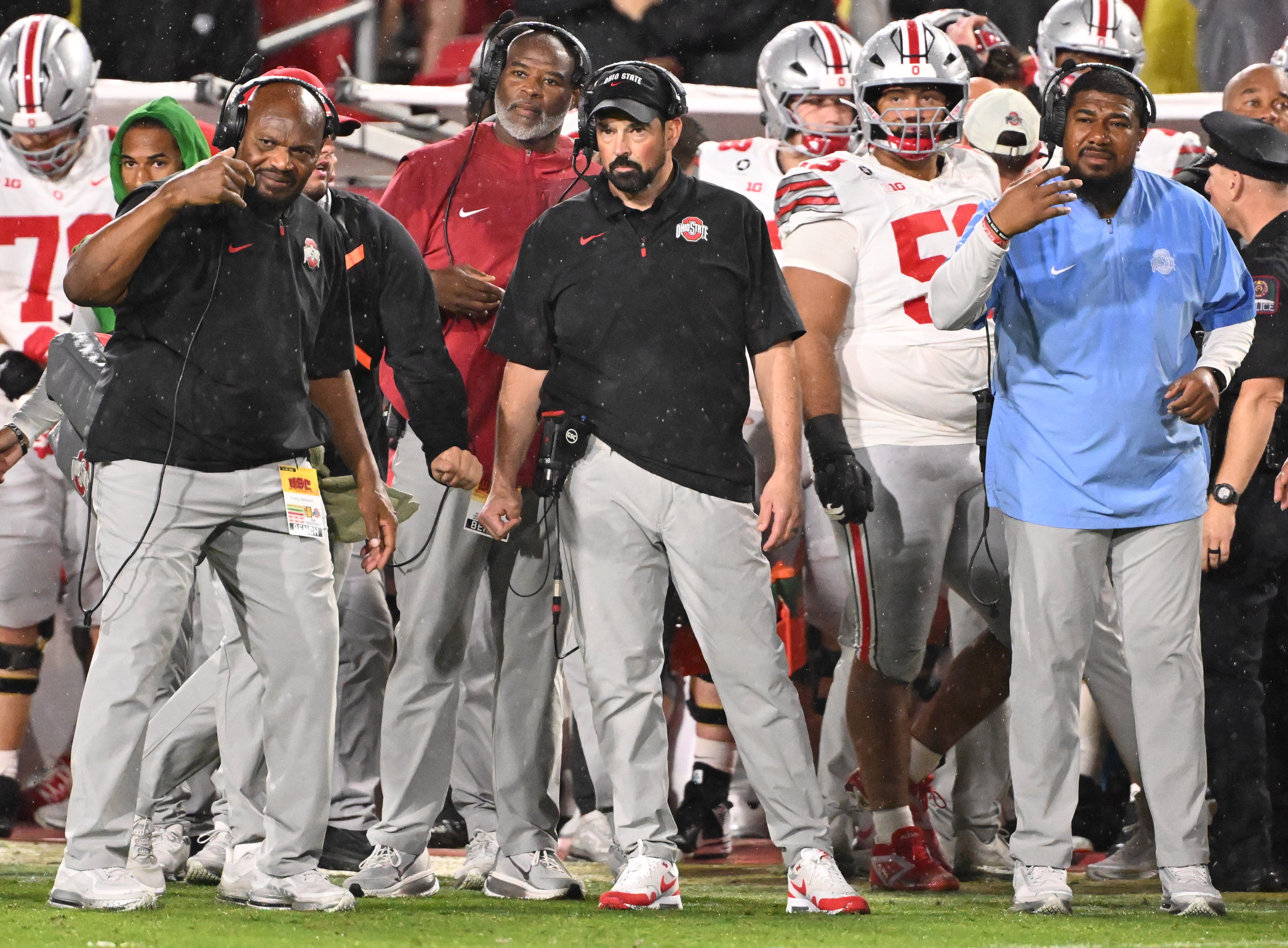
Though we don't know for sure if Sayin has an opportunity to return after the serious arm injury he suffered a couple weeks ago at Indiana, Ohio State's 30-18 loss at USC is a telling result. With freshman Luke Fahey thrust into the starting quarterback role, Ohio State is nowhere near the same team — and, if we're being honest, not a College Football Playoff team.
On one hand, the Buckeyes are 6-2, which puts them in the same bucket as a whole bunch of teams right now in the Big Ten and SEC that could theoretically win out and realize their postseason ambitions. But the eye test tells a different story: Not only did Ohio State's offense struggle for much of the game with Fahey at quarterback, but the defense completely disintegrated against a USC team that hadn't exactly been lighting the world on fire the last few weeks.
Just consider the highlight-reel play made by USC freshman tight end Mark Bowman in the third quarter. Trailing 20-9, the Buckeyes are still in the game if they manufacture a stop. Instead, Bowman gets wide open in the middle of the field, hurdles a defender like he's at the Olympics and then evades a couple tackles until he goes out of bounds at the 3-yard line for a 70-yard gain. USC scored a couple plays later and that was effectively it for the Buckeyes. Sayin's injury had nothing to do with that play or the overall defensive breakdown against USC, but when the there's such a downgrade at quarterback, it all falls apart.
Though there are plenty of two-loss teams that still harbor real postseason ambitions, we have to look at the precedent set by Florida State in 2023. When the Seminoles lost quarterback Jordan Travis to injury, they weren't the same squad and got excluded from the four-team CFP despite being undefeated ACC champions. The playoff is now 12 teams, but Ohio State can't present any evidence of playoff-quality offense so far with Fahey at the controls. Even Wisconsin, which scored zero points this week at Iowa, managed to put up 24 on USC's maligned offense last week.
That's how much of a struggle it was for the Buckeyes. Unless Sayin can come back, and soon, Ohio State is probably going to miss out on the chance to compete for a title simply because of bad luck.
In the month of November, Ohio State will play Oregon, Northwestern, Nebraska and Michigan. Those are all winnable games, but they're also games the Buckeyes can lose if they look anything like they did against USC — and their margin for error is basically gone. It's hard to see how Ohio State can navigate that stretch unless Sayin comes back or Fahey improves significantly in a short period of time. As much as Ohio State fans love to nitpick Ryan Day for losing his play-calling aggressiveness under pressure, no coach has great answers when the quarterback they built the team around is in street clothes.
In the end, this is probably going to end up as one of those years where a fluke injury to one player altered the course of history. We'll never know if Ohio State was actually good enough to win a national title, but we already have enough evidence to say they're not without Sayin. That's why Ohio State is America's most miserable fan base in Week 9.
Conference Champions of Misery
ACC: Because Virginia has no real history of sustained success, the Cavaliers don't get held to a high standard. At the same time, it's fair to say no team in the country has been more disappointing this season. Instead of contending for the ACC title and a CFP berth as so many Virginia fans expected, the Cavaliers have become a team that folds up the tent as soon as things get tough. Though Wake Forest has played excellent football all season, losing 51-7 and allowing scores on nine consecutive possessions is about as embarrassing as it gets for a Virginia team that came so close to winning the ACC title last season. Now, roughly 11 months after losing to Duke with a CFP berth on the line, the 4-5 Cavaliers are going to need to score an upset against either North Carolina or Virginia Tech just to make a bowl game. At this point, there's a good chance that Tony Elliott will finish with a losing record for the fourth time in five years. That would put last year's 11-3 record in a different light. Instead of Virginia turning the corner, it now looks like a complete outlier.
Big 12: We learned this week that Brett Yormark, who has been Big 12 commissioner since 2022, is leaving the conference at the end of the year for another opportunity outside college sports. Across the industry, there's a strong belief that one of the factors in Yormark's departure is how little influence he actually had in a world where the SEC and Big Ten have veto power over all the big decisions. Is that unfair? Probably so. But at the same time, how much autonomy can you give a league where you're counting on Cincinnati to be one of your better programs? Though Yormark was not responsible for the round of expansion that brought Cincinnati into the conference — that occurred under his predecessor, Bob Bowlsby — the Bearcats have not lived up to their end of the bargain. Just when it looked like they've finally got this thing figured out with a big win over Texas Tech last week, they lost 49-25 at home to Utah in a game that wasn't competitive for a single second. Cincinnati has been successful in every conference it's been in. But since joining the Big 12, it's just 11-22 in conference games, which is a massive disappointment for a league that needs Cincinnati to be more competitive than this. After this result, there may finally be some real pressure on coach Scott Satterfield heading down the stretch of this season.
SEC: The biggest mystery in college football is why Oklahoma saw fit to give Brent Venables a contract extension shortly before this season began. Yes, it's great that the Sooners made the CFP last season. But Oklahoma is one of the sport's historic blue-blood programs, and it's bizarre that the administration there decided one playoff appearance meant Venables needed to be locked down contractually through the 2031 season when nobody else was itching to hire him. Now look at the results. This year has been so ugly that if not for the contract extension, we'd be talking about whether Oklahoma should fire Venables after a 42-25 loss at home to South Carolina. Instead, the Sooners' fan base is going to spend the rest of this season stewing in rage at the school's administration for a coaching decision that didn't make sense on any level. In his first four years, Venables went 6-7, 10-3, 6-7 and 10-3. Even if you give grace for the difficulty of transitioning to the SEC, Venables has not compiled a record that would make any Oklahoma fan feel confident he's the right guy for the long term. Like most of his tenure, this season has been a mixed bag with a win over Texas but some really bad losses, including Saturday’s. Look, Oklahoma is never going to have it as easy in the SEC as it did in the Big 12. Being a traditional power doesn't mean that much in a league where there are lots of traditional powers. South Carolina, however, is not one of those powers. And if you're getting crushed at home by the Gamecocks, you probably shouldn't have a contract that pays you $10 million a year for the next five seasons.
Group of Six: Anyone who has followed the Protect College Sports Act's journey through Congress knows that a major reason Washington Sen. Maria Cantwell got so involved in college sports legislation is because one of her constituent schools, Washington State, got wrecked by conference realignment. Once a member of the old Pac-12, the Cougars wandered through the wilderness for a couple years before re-emerging as a foundational member of a newly configured Pac-12. The problem is, the new Pac-12 is nothing like the old version. And when you see the Cougars now as a 1-8 program that just lost 26-20 to San Diego State, it's fair to ask why a member of Congress is intervening on their behalf. Yes, partly because of the realignment mess, Washington State lost excellent coaches in Jake Dickert (now at Wake Forest) in 2024 and Jimmy Rogers (currently at Iowa State) after last season. But that was going to happen no matter what in a sport where coaches who win under tough circumstances have options. The bottom line is, no amount of government intervention can stop the separation between the haves and have-nots in college sports. No matter what kind of legislation Cantwell co-sponsors in congress, Washington State is going to be at the mercy of dynamics they have no control over. They will either be good and lose more coaches to power conference offers, or they will be very bad like they are now under first-year coach Kirby Moore. There's not much in between.
Headset Misery
P.J. Fleck: There are some losses in college football where you simply have to just throw your hands up to the sky and say, "What are the odds?" When Minnesota kicker Luke Drzewiecki drilled a 60-yard field goal with 19 seconds left to take a 16-13 lead over Indiana, nobody could have envisioned losing that game in overtime. But one 33-yard pass by Indiana's Grant Wilson set the Hoosiers up for their own 60-yarder by Paddy McAteer, who isn't even their regular kicker. A few minutes later, Indiana had won in overtime, 23-16, while the Gophers were left to deal with the emotional fallout of a loss that couldn't have seemed possible after they took the lead. Honestly, you can't point to anything Fleck did wrong here. He got his team in position to win the game, his kicker made an incredible field goal to give them the lead, and Indiana simply snatched it back because that's what great programs tend to do. At the same time, though, what a missed opportunity for Minnesota not to close this one out. If they had simply held on for a few more seconds, the Gophers would have been 6-2 with a real shot at the playoff coming down the stretch of the season.
Jon Sumrall: At this point, it's a right of passage to come to Florida and get blown out by Kirby Smart. Ignoring Smart's first season at Georgia in 2016, Saturday was the Bulldogs' ninth win in the last 10 years — a run that resembles Steve Spurrier's dominance over a series of Georgia coaches between 1990 and 2000. During this current stretch, the average score of Georgia's wins is 34-15, so it's not necessarily a reflection on Sumrall that his first try resulted in an ugly 27-8 beatdown. However, Sumrall has a big coaching challenge going forward as he establishes himself at Florida. How can he close the massive gap between the highs and lows his team has shown this year? The Gators have been good enough to beat Ole Miss by 24 and win at Texas but were blown out by Missouri and South Carolina while looking like they didn't even belong on the same field with Georgia. There was a little bit of that trait in some of Sumrall's teams at Tulane, too. When they were good, they were really good. When they were bad, they were really bad. That kind of whiplash won't work over the long haul in the SEC.
Jeff Lebby: In three years as Mississippi State's head coach, Lebby is 11-22 overall and 3-19 in the SEC. It's an objectively terrible record. But for the first part of this season, there was a lot of excitement around Mississippi State because they were 4-0 with a quarterback in Kamario Taylor who looked like a transcendent talent. Now, with Taylor sidelined by a turf toe injury that required surgery, Mississippi State has been relegated back to the dregs of the SEC. Without Taylor for most of their last three games, they've been outscored 85-18 and it could get worse. The point is, we now know any success Mississippi State had this season is because of Taylor, not Lebby. But the latter is getting paid more, which creates a conundrum for a school whose hopes of remaining relevant have little to do with the head coach.
Matt Rhule: As close as it may have felt to a Nebraska breakthrough earlier this season, it's the same old story again and again. The Huskers committed three turnovers and lost at home to Washington, 17-10, despite holding the Huskies to 267 yards of offense. Given the entire context, it's probably the worst loss of Rhule's career. A few weeks ago, the Huskers were 5-0 and had Indiana on the ropes with a 17-6 lead early in the fourth quarter. Now they're 5-3 and look like a program that has totally lost confidence in its offense and its ability to close out close games. Nebraska hasn't beaten a ranked opponent since 2016, but that no longer seems like the appropriate narrative. In its three consecutive losses this month, Nebraska has been outscored 39-10 in fourth quarters by a wide array of opponents, including a Washington team that had been pretty horrible for most of this year. That suggests a coaching problem and a confidence problem, and Rhule is running out of time to convince the Nebraska fan base that he's capable of fixing it.
Moments of Misery
Notre Dame's schedule got downgraded: The Fighting Irish eventually put away Navy, 35-13, but the more important developments with respect to their playoff chances happened elsewhere. With just two opportunities to register marquee wins — one of which already went by the wayside in a loss to BYU — Notre Dame was hoping its season-opening win over Wisconsin and a Nov. 21 game against SMU would hold up as important wins. That's not going to happen. Though Wisconsin has some winnable games remaining and could end up with a solid record, losing 30-0 to Iowa does not flatter Notre Dame's strength of schedule. As for SMU, giving up 10 points in the final six minutes to lose 30-27 at Syracuse stamps the Mustangs as decidedly mediocre. Unless Notre Dame can beat Miami next week, the Irish will need mercy from the selection committee to get in because it will be hard to justify a 10-2 record with no good wins.
BC's ugly number: Few things in football are as embarrassing as ending a game with two points. Honestly, getting shut out is better. At least that's forgettable. But when you comb through the history books, having a "2" next to your name sticks out like a sore thumb. Everyone remembers that that time your favorite team played so badly that its only points came on a safety. And Boston College's 47-2 loss to Duke is even funnier because its two-pointer came via returning a blocked extra point. It's the first time since 2005 in college football that a team's only points came via that specific type of scoring play. All in all, it made for a pretty sad day for a BC team that had been playing pretty well lately. Instead, not only did the Eagles get smoked, the lore of this performance will live on for years with BC fans like a sick, twisted inside joke.
.@TaitReynoldsQC showing off the wheels 💨
📺: ACCN pic.twitter.com/rUzgHHReu9— Clemson Football (@ClemsonFB) November 1, 2026
Florida State's follies: If the Seminoles could have simply stopped a third-and-12 play from Clemson, they'd have gotten the ball back with about three minutes left and had a chance to secure a monumental comeback victory. Instead, they let quarterback Tait Reynolds escape multiple tackles in the backfield and scamper for a 79-yard touchdown run down the right sideline that put the finishing touches on a 36-24 Clemson victory in Tallahassee. More than any other singular play, that one felt like the end of the Mike Norvell era. Though Florida State does not want to fire Norvell — or, more specifically, it doesn't want to pay a buyout of roughly $50 million — the current state of the Seminoles program is impossible to defend. They're just bad in general and really bad in the moments like that one that win or lose close football games.
Source: Yahoo Sports


Sign in to join the conversation.
Comments, replies, Roars, reports, and followed-thread notifications use your verified Rally & Roar account.
Sign in or create an account