


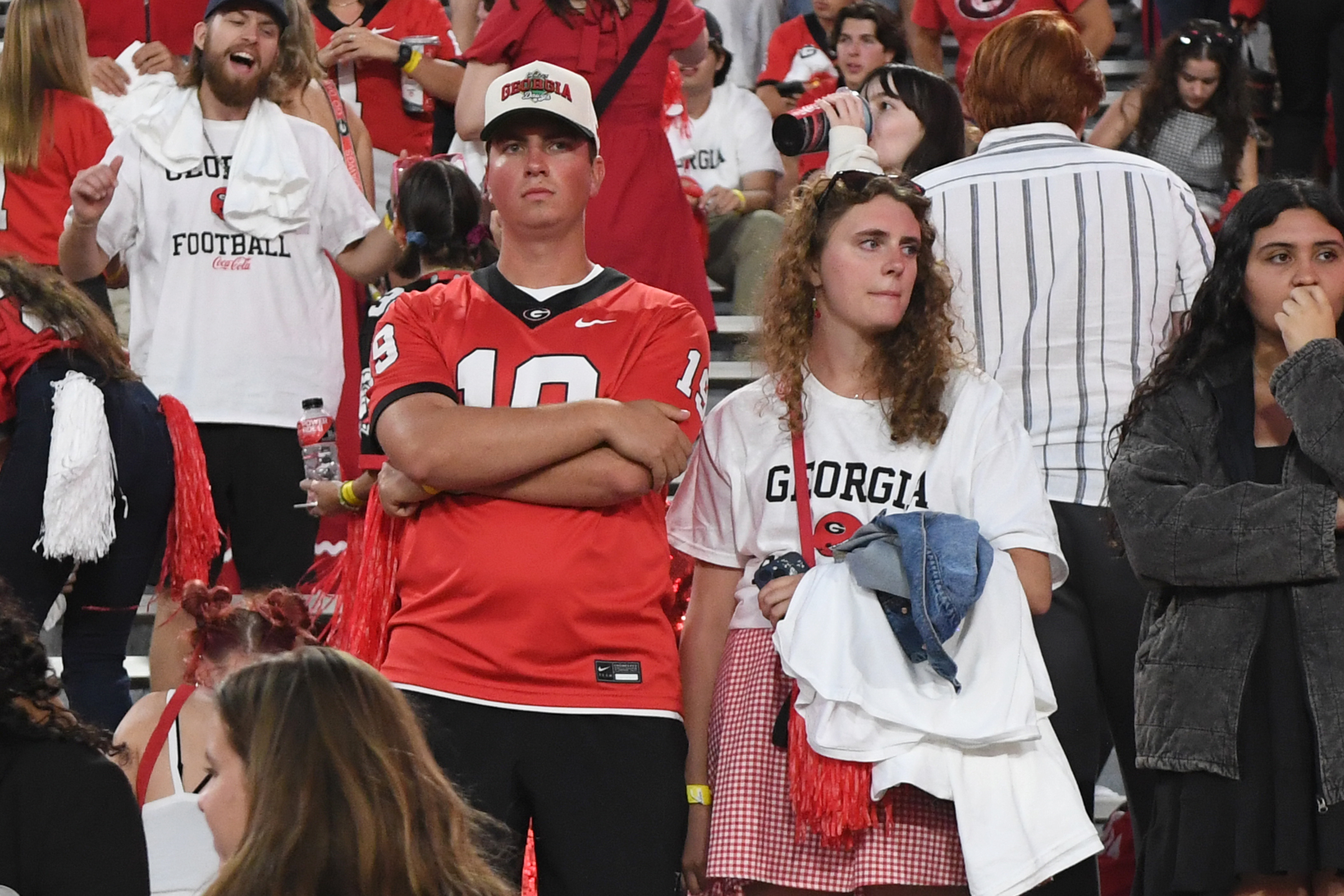
There's a feeling that comes over a stadium, a fan base that's in the process of losing a game it expected to win. There's usually a healthy dose of rage, to start, fury at those biased refs or an incompetent coaching staff or the players who just don't want it as much as they used to. But after the rage fades, the dread rolls in, the disbelief, the awareness that a bright and sunny future just got a bit — or a lot — darker.
Texas knows this feeling, thanks to Florida and Oklahoma. Ohio State felt it after falling to Texas, and coming within half a foot of losing to Indiana, too. BYU may not know exactly what happened in their loss to UCF, but they know what it felt like. Georgia knows it, thanks to Auburn, and Alabama knows it thanks to Tennessee. Everybody's kicking Oregon around. Miami and UCLA and Utah, your time is gonna come.
Welcome to the new reality of college football. Don't ever get too comfortable, because the losses are coming.
Right now, there are only three unbeaten FBS teams: No. 1 Miami, No. 9 UCLA and No. 10 Utah. The most recent time we've had so few unbeaten teams at this point in the season: 2003. As The Athletic notes, the average number of undefeated teams remaining after Week 8 in the 12-game playoff era is 7.8. That's so many more unbeaten teams than we have now! So many more fan bases that haven't had to make that long, "but what if we suck?" walk back to their tailgates after a humiliating loss!
The overarching reason for the increasing slide toward parity ought to be obvious: NIL and the transfer portal have led to a dispersal of talent across the college football universe. Where star recruits in, say, the Saban era might have accepted sitting behind fellow stars for a season or two, waiting for their opportunity, players now want the immediate payoff of a starting gig … and the NIL money that accompanies it. And that's totally understandable!
The downstream effects of this, though, will be fascinating to watch. The Athletic notes that the average number of undefeated teams in the NIL era (2021 to 2025) after Week 8 is 7.4, not all that different from the pre-NIL era — but then that's a pretty small sample size. (This year's three will pull that average down to 6.67.) In the coming years, absent any other changes to the current system, the shocking outcomes will become progressively less shocking.
Consider, for instance, team cohesion. A college program isn't a fantasy football team; you can't just throw together any random 11 players who accepted your NIL deal and expect them to post the same numbers at any stop. Quarterbacks and receivers, offensive and defensive lines, secondaries all need time to bond and connect as a team, learning each other's tendencies and having each other's backs.
Plus, consider the effect of injuries. Teams don't have the funds to invest in two full Saban-esque starter-level lineups, and most players won't take less when more is available elsewhere. So when a starter goes down, the backup might be ready … or might be a huge downgrade. (Oregon and Ohio State are both facing this exact challenge at quarterback.)
All of that combined leads to what we've seen over the last few weeks: No. 1s and No. 2s losing to unranked teams, fields getting stormed, fan bases in agony because they're still filtering these losses through their pre-NIL filters. The reality is, virtually every "elite" team is going to lose to an underdog in a given season, and probably more than once.
Where the unfamiliar pain is really going to kick in hard, however, is the playoff. There was a time not so long ago when you could count on college football's ruling elite the way you count on the sunrise. In the seven College Football Playoff installments of the pre-NIL, pre-portal era — i.e. the 2014 to 2020 seasons — Alabama and Clemson reached the playoff six times, Ohio State and Oklahoma four apiece. Georgia and Michigan have elbowed their way into the picture since then, making four and three post-2020 playoff appearances respectively, and each winning national titles along the way.
But like a club ditching its cover charge, the playoff is losing its exclusivity — and, by association, its cachet. A playoff berth alone isn't an honor for most top programs, it's table stakes for coaches to keep their jobs. And it just means more potential for heartbreak from an unexpected angle. More teams + more widely dispersed talent = more stunning upsets.
You can shrug off a loss to an underdog in September or October, particularly when everybody else is plummeting around you. But when it's December and you're down three possessions to an underdog in your campus stadium, well … that's when the real pain starts.
So what does this all mean for programs and their fans? For starters, maybe step back from the cliff every time your team loses a game. We all know hardcore fans who stress so badly over losses that they punch TVs, fight with relatives, put themselves into hospitals or poison trees; maybe it's time to counsel a bit of moderation.
In the big picture, bad September and October games now ruin weeks, not entire years. No single regular-season game will ever hold the same apocalyptic postseason importance again. Plus, when the dark, miserable cloud of loss does rain down on your team, take heart: You'll probably get the chance to do the same thing to someone else next week.
Source: Yahoo Sports


Sign in to join the conversation.
Comments, replies, Roars, reports, and followed-thread notifications use your verified Rally & Roar account.
Sign in or create an account